Before you figure out a new place, you’re running on first impressions and feel, influenced greatly by your mental state the moment you arrive. Having done very little research on the Caribbean island nation of Curaçao, (typical of most of my travels), I was running on the little information I’d gathered from my dad. A small, flat, mostly desert island. I hadn’t been excited to spend four full days there.
But, after three days at sea, just the two of us, working his sleek wooden sloop expertly downwind, I was quite invigorated and inspired as the sun rose over Bonair, and as we sliced up Curaçao’s south coast and through the narrow inlet into Spanish waters.
I hopped around the narrow teak deck from side to side, marveling at the channel cut between straight rock walls. A Caribbean island with such a deep set lagoon was a marvel to me, and I wondered how it was formed. Even the Sandal’s resort made me giddy, with real thatched cabanas, fine white sand, and a floating dock sliding just meters past our starboard side. I waved back happily at a beach walker.
We cruised up the long bay, pocked with mangrove coves and wide anchorages. To our right sprouted a development of elegant architecture, hanging on solid rock ledges. The desert landscape lent an air of tidy stillness to the bay, and when we finally pulled into our slip at the small Seru Boca marina, an intoxicating silence descended, so stark against three days of tossing and sloshing.
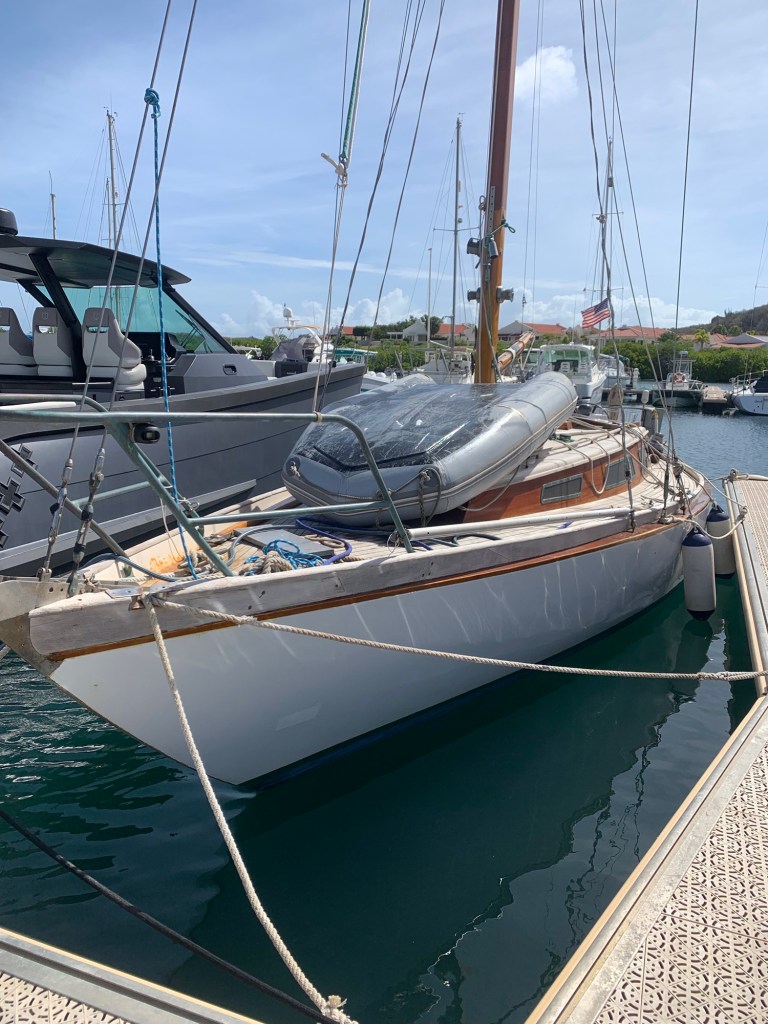
I was giddier still to be at a dock. As a kid, staying in a marina was a luxury. It meant limitless water and limitless freedom. We could jump off the boat at will, tearing up and down docks, running errands without having to wait for the dinghy. The effect was not lost to me as an adult. I hopped onto the bobbing dock, testing legs that had been fighting to stand for three days.
Beyond the marina and a cluster of elegant tiled roofs was rolling desert, a modest golf course, and a high mountain peak, scarred with terraces that puffed dust as they mined the stone to make cement blocks. The marina was nestled deep in a gated community at the South end of the island. To get to customs we would have to dinghy a mile to the other end of the Spanish waters.
”Do you think the bus will be air conditioned?” I asked eagerly.
”Nah,” grumbled Dad, as we puttered down the bay with the wind at our back.
We waited for the public bus in the stingy shade of a stunted tree, at a black and white striped curb. Beatlejuice curbs, I came to think of them. Jolly in a way. ”Well what do you know!” said Dad, as a sleek city bus pulled around the traffic circle and stopped. They’d been upgraded since his last visit in December, when he’d returned for the boat after hurricane season.
As we stepped into the air conditioning, I greeted the bus driver, excited to see what kind of island culture I’d encounter. Would we have proud, sassy Latins, stoic, impatient Virgin Islanders, or maybe sweet amusement, like the little I’d experience in St. Vincent. I hoped I wouldn’t run into gringo resentment, but of course I’d always understand if I did.
I smiled wide and nodded and she smiled back genuinely and then hurried me along. Sweet but efficient, definitely in charge. She owned the road and kept us bustling along smoothly and steadily. I tuned into the bubbling language around me, catching some Spanish words, some Portuguese, and something else, watching the crowd tease and encourage each other softly, calmly, like a people at ease. I gawked out the window at smooth bleached roads curving through neighborhoods of classic Dutch construction, tiled hip roofs among more modern shopping centers. Groves of sturdy trees popped up along our route, which delighted me, unexpected on a desert island.

The bus dropped us in the center of Willemstad, along a wide creek lined with bobbing Venezuelan merchant boats, and stalls of trinkets and produce. We hustled past keychains and hats and papayas and pineapples to the stark corner customs office. I took note of the heavy glass doors and windows, quality construction, perhaps indicative of a wealthy island nation, or at least one unburdened by the constant setbacks of hurricanes and earthquakes.
The customs official was another sweet plump woman a little older than me, and she spoke in a slow, timid English. She asked if we had filled out our online paperwork.
“No, no, we just got here, we don’t have cell phones,” said dad, as he pulled out his iPad, flustered by all the new technology and procedures, after a lifetime of bare bones sailing and carbon copy forms.
She handed us a laminated QR code for Wi-Fi and I swiped the ipad from my father, smiling at her, explaining how frustrating the technology was.
”What are you, eighty?” she asked my dad. For a moment I thought she was taking a jab, but then I saw that she remembered him. He had told me how in December he and his wife had tried to leave for Puerto Rico in twenty knot headwinds, and came back to wait it out. When they returned to customs to extend their stay, the sweet lady had asked how old he was, wide-eyed when he told her.
”Well, seventy-one,” he chuckled, reminding her, calming down as I took over the internet and left him to socializing. He could have figured it out, but it would never be easy or pleasant for him, so for now, I was there to help. And to make it easy and pleasant for both of us.
“And you,” she said to me, looking at our paperwork, “live in Puerto Rico?”
I nodded, “Yes, I came down to help my father sail from Bequai.”
”Ah,” she considered, “so this is your father? And Dana is your sister?” she asked, remembering the other young woman my father was traveling with.
My father and I started to answer at the same time. “No,” I smiled. “Dana is his wife.”
”Ah, ok,” she smiled.
I smirked. Dana is fifteen years younger than my father, although a nearly perfect match in adventure and resourcefulness. A month earlier she had to fly home to be with her sick father. So I was tagged to help crew and store the boat.
As I saw that our official was in no rush, that she was intrigued and amused by my father and I, I stole some moments to ask about her island. The bubbling, smooth language was the island dialect, called Papiamento, a mixture of Spanish, Portuguese, and English, she said. Although I felt like I heard less English and more Dutch. But she said most people speak English and if they don’t, they speak Spanish.
We still had to go to immigration, which Dad assured me was the most absurd and obnoxious distance from customs for a couple of stingy sailors without a car or a taxi. He promised our kind official that he would come back with the immigration form, but she assured me again and again that it was actually easier for me to send it over WhatsApp, so I agreed and we shuffled out of her office.
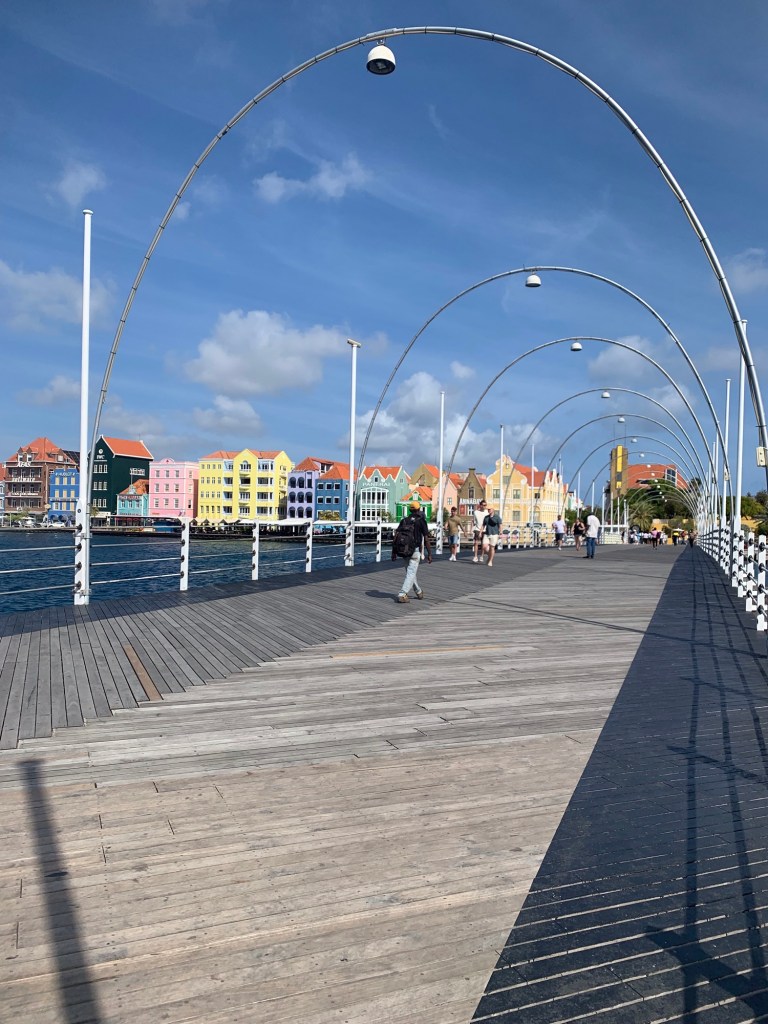
The ocean came right into the city, cutting it in half with a wide inlet. Colonial Dutch buildings lined each shore, colorful and restored into restaurants, hotels, and shops. Cruiseships docked outside of the inlet, depositing their cargo of shoppers, while cargo and oil ships came right in, passing through a rotating pedestrian bridge and then under a soaring car bridge. Beyond that spread out another vast inland bay, full of decommissioned oil refineries.
I gawked as the floating bridge swung closed behind a passing ferry, and then sauntered across among the wave of other walkers. Dad put his head down and charged New York style through the crowd, his private little game of frogger, and we met on the other side.
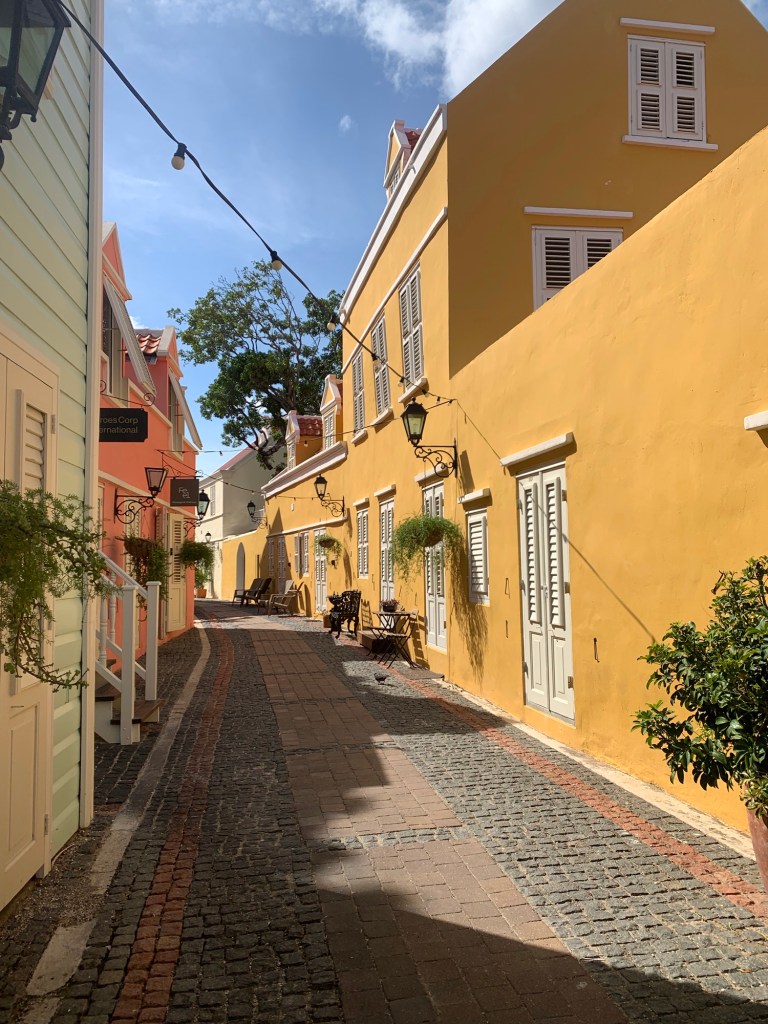
The immigration office lay at the bitter end of a dismal industrial dock, through a security gate, and then several hundred meters past abandoned looking warehouses and a towering oil ship. We passed a pile of old, weathered timbers, and Dad eyed it greedily, forever the carpenter. These officials were less engaging, and slightly less capable, but after another round of vague online forms and recorrecting paperwork, we were released to explore the cobbled alleyways and ancient architecture on our way back to the bus station.
We cleared in a second time the next day, once the marina office had opened. I brought the paperwork to the young man managing the marina, and he was surprised that we had already cleared customs, that after three days at sea we had undertaken a dinghy ride and bus ride to town. The dinghy ride home had been a bit more rough, a mile up the bay against the wind and chop. We had stripped down our shirts and charged ahead, committed, prescribed to get soaked. I told Dad that I was considering it another day at sea, bringing our passage to four, instead of three.
As I sat in the marina office, he also seemed in no hurry to shuffle me out. We were early for the hurricane season, things were slow, so I took the opportunity to flirt a little and learn about the island. He had returned after six years in Europe. How was it living here?
He said the quality of life is better, the appreciation of life. It is expensive of course, with import duty and shipping taxes on everything, but that went right to the Curacoa government, as an independent nation under the web of the Dutch, and infrastructure seemed clean and efficient to me, especially compared to Puerto Rico. We compared utility prices which seemed on par with Puerto Rico.
Like our customs official, he was interested in our situation, asking me about the sail, surprised that Dad had children. “So, you are Dana and Julien’s daughter?” he asked. Again I cleared things up. And as soon as I trotted back to the boat, I tormented my dad.
”Oh my god, everyone around town must be going crazy wondering about your love life!” I chided. “You come here twice with one young woman, and then you cruise all winter and come back with a different one! I bet they were dying to ask. They must have thought you were just another old rascal captain!”
“Ha, yeah maybe,” he chuckled from his perch at the navigation table.
Then we set to the task of prepping the boat for storage. I like to travel with a purpose, and without spending too much money, so sailing is ideal. We had our food and lodging, and I had a role.
I found my own tasks, deep cleaning and organizing, while Dad set about dealing with sails and lines and engine maintenance. I worked slow and reveled in the peace of place, the deep sleep I was finally getting, the silent mornings in the marina, the breeze pulsing through the bay keeping us cool. And the freedom to hop off the boat for a walk.
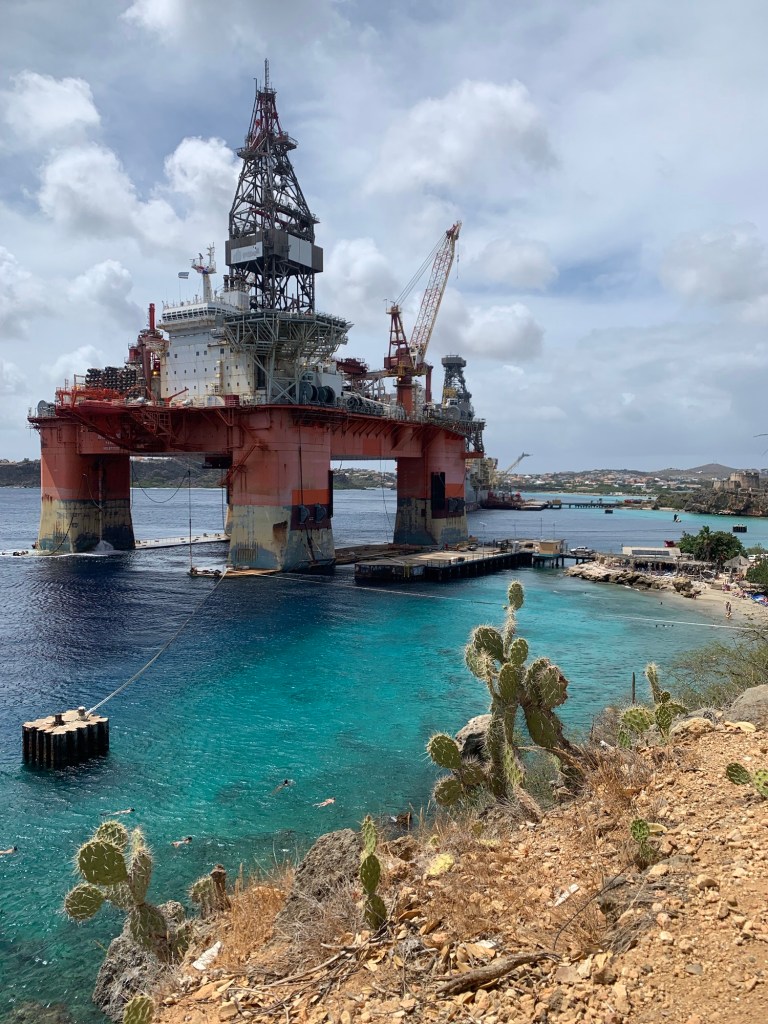
After two days of work though, we finally decided to rent a car, so we could explore the island a little between tasks. We headed north towards Carracasbai, to the old fort and barracks, climbed three levels to the cannon turret, now overlooking a monstrous oil platform and ship, and people snorkeling and sunbathing in their shadow and fumes. Then a walk through a beachside resort, cabanas with beds, a live DJ streaming her music through scattered speakers, drink and snack huts. Very European. We stopped for an ice cream and the server patiently answered our flustered questions, quizzical almost as to why we were so rushed when even she was not. Everyone I had met so far had an air of practical peace.
We stopped in a grocery store to buy a piece of pre packaged fish for dinner. At the check out, I asked the sweet cashier how to say thank you, since so far I’d been saying it in English, and sparking the biggest smiles regardless.
She smiled and said, “Danki.”
A sweet ringing word, childlike almost. Impossible not to like. I tried it out. ”Danki,” I said, and she beamed back bigger than I had seen yet.
”De nada!” she said.

My last day we quit at noon and took off for the far end of the island, the “Westpunt”. I drove, and fell right into the flow and rhythm of traffic, respectful and fluid, a dance, a collaboration, like many islands I’d been to. A couple of times I flashed my lights to let someone go, and they always waved and smiled. One man flashed his lights back emphatically, another woman blew me a kiss.
So maybe gratitude is enough to explain a culture. A culture unburdened perhaps by the pressures of colonialism, or the poverty of natural disasters, so that life is not a constant struggle just to try and get ahead. Maybe there is a calm that comes from feeling taken care of by your environment, maybe even your government. And maybe in that calm, the rush of feelgood that comes from gratitude, from eliciting a smile from a stranger, is all the more apparent and potent. And maybe that positive reward snowballs into an island of people cooperating and looking out for each other. Or maybe I was just feeling enamored.
Which didn’t change as we headed west. We drove all the way to the end, down the final miles of lumpy dirt and stone. My father and I, testing yet another rental car to the limit. We stood on the rocky plateau at the edge of the island, as the sea surged against the cliffs, spouting water up through blow holes in the coral rock.
Then we picked our way back along the coast, stopping in at each cove on the map, staying long enough to take it in, the little sand strips tucked between neat rocky points, water the color of glacial lakes, clear and cool and refreshing. We dipped down to the public balneario, a charming local beach with thatched umbrella cabanas and a restaurant at one end. I stood and chatted with a seasonal Dutch woman, watching her puppies play in the sand, talking about the dog and cat rescue programs on the island, until the late afternoon sun started to bake my shoulders and we headed back to our air conditioned hatchback.
It was getting late and we were getting hungry, but took one final detour off the main road, following a dead end route to the Saint Martha viewpoint. Something told us this would be a good one, we were trusting each others’ guts and coming out successfully. Or maybe just everything was beautiful on that island.
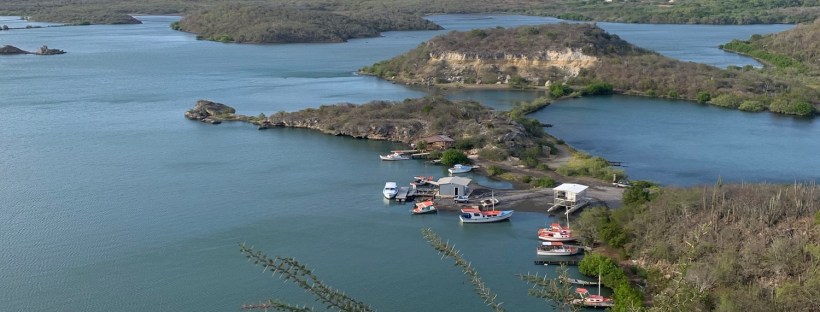
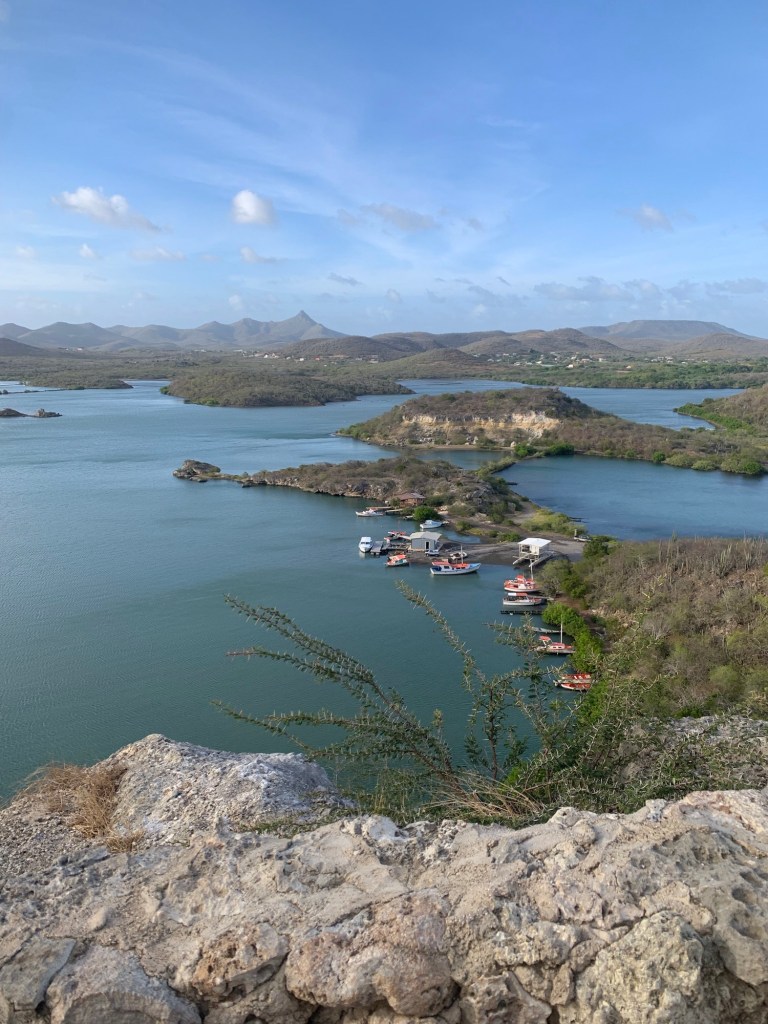
There was a blurry blob of a lagoon on our map and we didn’t know what to expect, but as we stepped from our car, past the overflowing garbage at the viewpoint pullout, we found ourselves high above yet another beautiful, expansive inland bay. Far on the other side, green pointy hills poked up, the higher mountains from where we had just come. One single idyllic Dutch mansion dotted the far side, and down below, a spit of land hosted a fishing camp, a handful of long, skinny launches anchored just offshore from a couple of small, sturdy warehouses.

Dad checked his navigation program excitedly. The inlet to the sea was narrow, barely thirty feet across, a harrowing entry, but it was deep enough for his heavy-keeled boat.
”Well shit,” he said, “Maybe next year I’ll just pull in here and pay the fisherman a grand to look after the boat for the year!”
We gazed over the bay for just the right amount of appreciation, and then turned to go at the same time. Our internal clock and attention spans seemed to line up perfectly at all these viewpoints. Must be genetics. But as we made our way back to the car, I stopped him. We had to clean up some trash. Picking up trash was our thing too, and we owed it to the island, which had given us so much. And we happened to have bags in the car, which we’d been using under our wet, salty butts to protect the seats.
“Oh, fine,” he grumbled, and we set to work filling our bags, which we then piled into the back of the little car. So much for protecting the seats.
As we picked our way again through towns and traffic, nibbling plantain chips and sliced Gouda appetizer on our way back to dinner on the boat, I remembered the schoolhouse I’d seen earlier, children at recess running around a shaded yard which made me smile, to see students innocent and joyful. The building itself was jolly and colorful. Something about those hip roofs, sloping pyramids like cozy little hats. And I imagined how I would feel going to school every day in a building that looked so jolly and fresh. How much a space and an environment can affect a mood and a culture, and vice verse perhaps.
I brought this up to Dad and he agreed emphatically, told me about a New York architect who made his whole career around this notion, built dozens of schools that are still in use today, in their original artistic form, on the premise that generations of students would be inspired to stay in school if their environment was elegant and encouraging. I thought of Puerto Rico, the square simplicity of the modern cement block construction, the drab hospitals, industrial looking schools, and cringed. Very little was built creatively. Going back would be a culture shock for sure.
Even leaving was calm and pleasant. Airport security was a dream. The airport itself clean and well lit and uncrowded. But as soon as I landed in Panama, city life came roaring back. Everyone crowded the isle to get off the plane, into an airport of rushing and bustling and advertisements. And I used to love Panama City. But maybe I was just too much an island girl these days.
A black bird was stuck inside the high glass walls, flying from window to window, perching on the frames and calling to her family outside. It broke my heart. I irrationally thought how in Curaçao we would somehow all come together to catch her and reunite her with her flock. Somehow Curaçao would make it right.
And then I laughed at myself. I’d fallen in love indeed. The rose colored eyes of a flyby tourist. Guaranteed there was an underbelly to my beloved Curaçao, but for now I was an enamored visitor. I’d arrived with no preconceptions, and I’d been blessed with an experience that had touched my heart. Which is more than I could have asked for.
 Knowing Home
Delighted to read your update! What a beautiful narrative of your visit. Makes me want to throw out my existing plans and go island hopping instead! What a wonderful island.
LikeLike
Haha, do it! 😜 Or at least a Puerto Rico venture when I have my house more ready;)
LikeLike
We have Puerto Rico on our short list! We’d love to come visit and explore.
LikeLiked by 1 person